From Brain Drain to Brain Circulation, and from Brain Circulation to Brain Gain
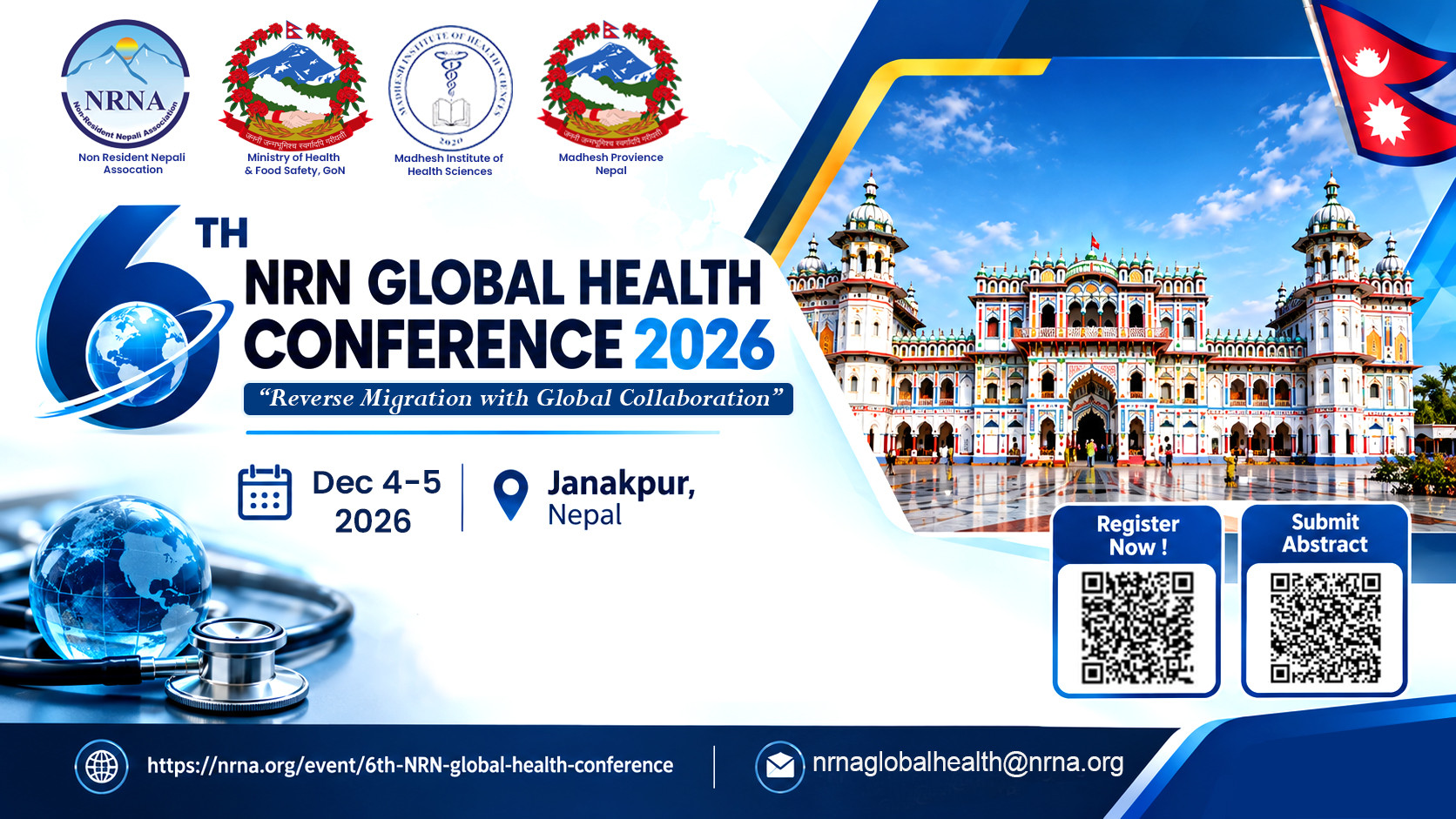
The Sixth NRN Global Health Conference 2026 will be held in the historic city of Janakpur, Madhesh Province, Nepal, on 4–5 December 2026. The conference is an international platform for government leaders, health professionals, academics, researchers, international organisations, development partners, private-sector organisations and members of the Nepali diaspora.
The theme, “Reverse Migration with Global Collaboration”, reflects an important opportunity for Nepal. The movement of health professionals across borders should not be viewed only as a loss of human resources. With appropriate policies, partnerships and opportunities, migration can become a mechanism for knowledge transfer, capacity building, innovation, investment and health-system strengthening.
Nepal has a large and highly skilled global health diaspora. Nepalese doctors, nurses, dentists, pharmacists, public-health specialists, researchers and other health professionals make significant contributions internationally. The conference aims to connect this expertise with the needs and priorities of Nepal.
Janakpur provides an important setting for this conversation. As the capital of Madhesh Province and an important cultural and educational centre, it offers an opportunity to take global health collaboration beyond Kathmandu and strengthen connections with provincial and local health systems.
Conference Objectives
- Develop practical approaches to reverse migration and diaspora engagement.
- Create opportunities for overseas Nepali health professionals to contribute to Nepal’s health system.
- Establish international hospital and university partnerships.
- Promote medical education, fellowships, specialist training and visiting faculty programmes.
- Strengthen research, innovation and international collaboration.
- Promote digital health, telemedicine and technology transfer.
- Encourage diaspora investment in Nepal’s health sector.
- Strengthen health services in Madhesh Province and other underserved areas.
- Develop a sustainable national framework for global health collaboration.
Anticipated Legacy
A major anticipated outcome is the Janakpur Declaration on Reverse Migration and Global Health Collaboration 2026, intended to provide a framework for future collaboration among governments, universities, healthcare institutions, development partners and the global Nepali health community.
The conference also aims to establish a Janakpur Global Health Network to facilitate continuing partnerships in research, education, specialist exchange, digital health, mentorship, healthcare innovation and health-system strengthening.
Message from the Chairs
Welcome to Janakpur
It gives us great pleasure to welcome you to the Sixth NRN Global Health Conference 2026, which will be held in the historic city of Janakpur, Madhesh Province, Nepal, on 4–5 December 2026.
This year’s theme, “Reverse Migration with Global Collaboration”, reflects an important opportunity for Nepal. The movement of healthcare professionals across borders should not be viewed only as a loss of human resources. With the right policies, partnerships and opportunities, migration can become a powerful mechanism for knowledge transfer, capacity building, innovation, investment and health-system strengthening.
The conference will bring together government leaders, health professionals, academics, researchers, international organisations, development partners, private-sector organisations and members of the Nepali diaspora. We will discuss practical approaches to reverse migration, international training, research collaboration, digital health, healthcare investment, innovation and strengthening health services, particularly in underserved communities.
Importantly, this conference should not end with two days of discussion. We hope to develop long-term partnerships and measurable commitments, including visiting faculty programmes, specialist training, research collaborations, hospital and university partnerships, mentorship programmes, digital-health initiatives and opportunities for diaspora investment.
We warmly invite colleagues from Nepal and around the world to join us in Janakpur. Let us move from brain drain to brain circulation, and from brain circulation to brain gain, creating a model of global collaboration that can contribute to a stronger, more equitable and sustainable health system for Nepal.
Prof. Dr. Sunil Sah
Chair, Conference Organising Committee
Prof. Dr. Padam Simkhada
Chair, Scientific Committee
Prof. Dr. Ankur Shah
Chair, Local Organising Committee; Vice-Chancellor, Madhesh Institute of Health Sciences
Call for Papers
Invitation to Submit
Researchers, practitioners, policymakers, students, diaspora professionals and institutional partners are invited to contribute work relevant to the conference theme. Submissions should demonstrate relevance to global health, Nepal’s health priorities, diaspora engagement, health-system strengthening or international collaboration.
Proposed Thematic Areas
- Migration, reverse migration, brain circulation and diaspora engagement
- Disaster response, health protection and health security
- Health systems, policy, governance and workforce
- Research, evidence translation and innovation
- Digital health, telemedicine and technology transfer
- Medical and health-professional education, fellowships and specialist training
- Maternal, child and reproductive health
- Non-communicable diseases and mental health
- Climate change, emergencies and planetary health
- Health equity and services for underserved communities
- Diaspora investment and institutional partnerships
Submission Information (Pending Final Approval)
- Abstract word limit: 300 words
- Submission deadline: 30 October 2026
- Decision date: 9 November 2026
- Presentation formats: Oral, poster, panel or workshop, subject to approval
- Submission method: Email
- Contact: abstract.health@nrna.org
Review Process
All submissions will be considered through the conference’s approved scientific review process. Detailed assessment criteria, decision arrangements and presenter guidance should be added after approval by the Scientific Committee.
Suggested Abstract Format
- Abstract title
- Author names, affiliations and contact details (email)
- Presenting author and email
- Background
- Aim or objectives
- Methods or approach
- Results or anticipated results
- Conclusion and implications
- Up to five keywords
- Preferred presentation format